



Introduction
Inquiry-based learning is central to the International Baccalaureate (IB) approach. Instead of simply presenting information, it encourages students to ask questions, explore ideas, and investigate real-world problems. The aim of inquiry-based learning is to spark genuine curiosity, paving the way for a deeper and more powerful learning process than memorisation alone.
High-quality IB textbooks play an important role in supporting this approach. While they are not substitutes for teachers, they act as structured guides that support inquiry by offering carefully designed prompts, real-world examples, and concept-driven explanations. When used effectively, they help students move from a surface-level understanding to deeper conceptual thinking that closely aligns with IB assessment criteria and markband expectations.
Key Takeaways:
- What makes inquiry-based learning different from traditional methods?
It focuses on questioning, exploration, and real-world application rather than memorising information, helping students build deeper understanding and long-term retention.
- Why is this approach important in the IB programme?
It develops independence, critical thinking, and research skills that are essential for academic success and aligned with IB assessment expectations.
- How do IB textbooks support this style of learning?
They include structured prompts, case studies, and concept-based explanations that guide students through analysis, evaluation, and reflection.
- What should students look for when choosing IB textbooks?
Books should be aligned with the latest syllabus, include strong analytical questions, and offer real-world examples that encourage deeper engagement.
- How does this approach benefit students beyond school?
It builds confidence, adaptability, and problem-solving abilities, preparing students for university and real-world challenges.
Understanding Inquiry-Based Learning in the IB Programme
2.1 What Is Inquiry-Based Learning?
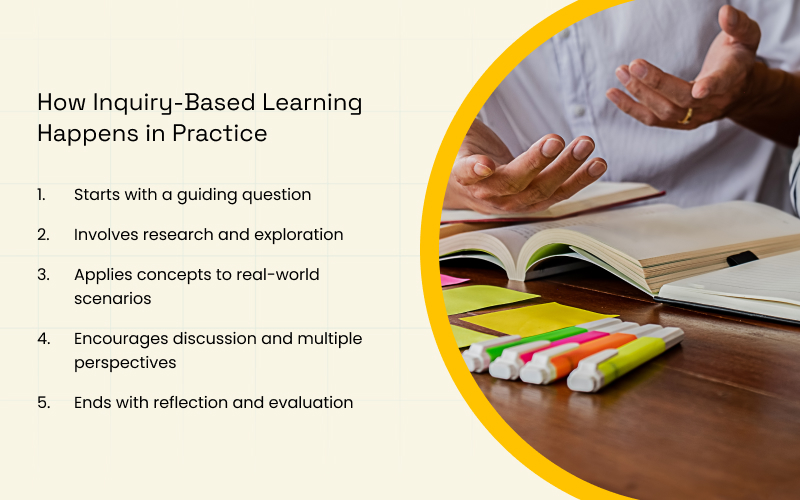
Inquiry-based learning (IBL) is a student-centred approach in which learners explore questions and real-world problems rather than passively receiving information. In practice, this often begins with a central question that frames the lesson. Instead of being told what to learn, students are guided to uncover it themselves through structured exploration.
For example, in IB Biology, students may be asked how environmental factors influence enzyme activity. Rather than memorising definitions, they design experiments, collect data, and interpret results. Through inquiry-based learning, they understand not only the concept but also the scientific process behind it.
Similarly, in IB English Literature, students might analyse how a writer’s use of symbolism shapes meaning. Instead of being given a fixed interpretation, they explore multiple perspectives, compare textual evidence, and construct their own arguments. This process develops analytical depth and personal engagement with the subject.
Key characteristics include student-led questioning, active investigation, and conceptual connections across topics. Reflection is also built into the process, as students evaluate what they have learned, identify gaps, and refine their thinking. This continuous cycle strengthens both understanding and independent learning habits.
2.2 Why the IB Uses an Inquiry-Driven Approach
The IB integrates this approach across the Primary Years Programme (PYP), Middle Years Programme (MYP), and Diploma Programme (DP) because it supports long-term academic development and personal growth.
One of the strongest reasons for adopting inquiry-based learning is that it promotes independence. Students learn how to manage their own learning process, from formulating questions to evaluating outcomes. This is particularly evident in the IB Diploma Programme, where students complete the Extended Essay. A student researching the impact of social media on consumer behaviour, for instance, must define their research question, gather data, and critically analyse findings without relying on step-by-step instructions.
It also encourages deeper understanding. When students engage actively with content, they move beyond memorisation to grasp underlying concepts. In IB Economics, rather than recalling definitions of supply and demand, students may analyse real-world case studies, such as government intervention in housing markets, thereby applying theory to practical situations.
Another important reason is that it prepares students for higher education. Universities expect students to conduct independent research, evaluate sources, and present structured arguments. Inquiry-based learning develops these skills early, making the transition smoother and more manageable.
At the same time, it reinforces the IB Learner Profile. Students become inquirers who are curious and motivated, thinkers who analyse critically, communicators who express ideas clearly, and reflective learners who evaluate their own progress. These attributes extend beyond academics and shape how students approach challenges in broader contexts.
2.3 What Are the Benefits of Inquiry-Based Learning?
The academic benefits of inquiry-based learning are closely linked to how students process and apply information. Instead of memorising content for short-term recall, they build a deeper conceptual understanding. This is particularly valuable in IB assessments, where higher mark bands require analysis, evaluation, and synthesis rather than simple description.
For example, in IB Mathematics, students are often required to interpret real-world data or model scenarios. A student exploring population growth may apply exponential functions to predict trends, then evaluate the limitations of their model. This demonstrates both conceptual understanding and critical thinking.
Inquiry-based learning also strengthens problem-solving and creativity. In IB Design Technology, students may be tasked with developing a product prototype. They must identify a problem, research existing solutions, and test their own designs. This iterative process mirrors real-world innovation and encourages flexible thinking.
Beyond academics, the personal benefits are equally significant. Students develop confidence as they learn to justify their ideas and present their findings. Communication skills improve through discussions, presentations, and collaborative projects. They also build resilience, as inquiry often involves trial, error, and refinement rather than immediate success.
Perhaps most importantly, this approach helps students connect learning to real-world issues. Whether analysing climate policies in Geography, evaluating ethical dilemmas in Theory of Knowledge (TOK), or interpreting historical events from multiple perspectives, students gain the ability to apply knowledge meaningfully.
Quality IB Resources Encourage Ownership of Learning
3.1 How Quality IB Textbooks Support Inquiry-Based Learning
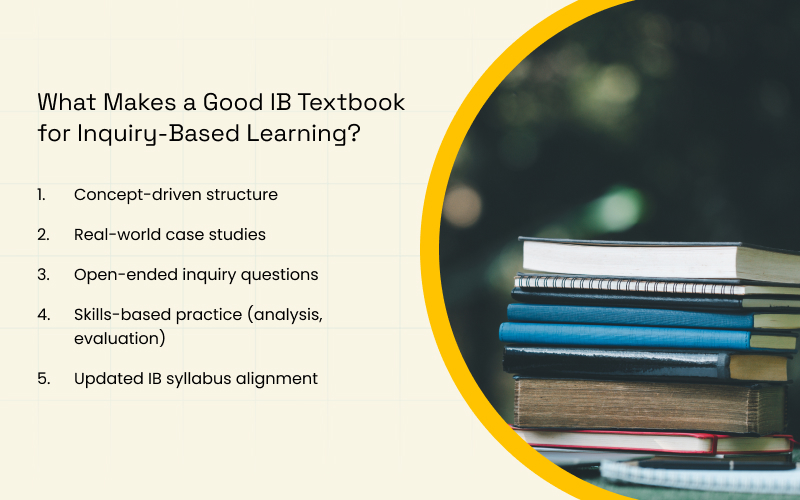
High-quality IB textbooks are designed to actively support inquiry-based learning rather than simply deliver content. One of the most effective features is the inclusion of structured questions that promote exploration. These go beyond factual recall and require students to analyse, evaluate, and justify their responses.
For instance, an IB Business Management textbook may present a case study on a multinational company expanding into a new market. Students are asked to assess risks, consider cultural factors, and recommend strategies. This type of task reflects actual IB exam questions and prepares students for higher-level thinking.
Concept-based learning is another key element. Textbooks are organised around big ideas such as change, systems, and relationships, allowing students to see how topics connect. In IB Chemistry, understanding the concept of equilibrium helps link multiple chapters, reinforcing a cohesive understanding rather than fragmented knowledge.
Real-world examples further strengthen learning. Many textbooks incorporate global case studies, including scenarios relevant to Singapore, such as urban sustainability or economic development. These examples make abstract concepts more tangible and relevant. Students working with well-curated International Baccalaureate books are more likely to engage meaningfully with content that reflects real-world contexts.
Skills-focused features are also embedded throughout. Activities such as data interpretation, source evaluation, and research tasks mirror the demands of IB assessments. These elements ensure that IB textbooks support both knowledge acquisition and skill development, which are essential for success in the IB programme.
3.2 How to Choose the Right IB Textbooks to Support Inquiry
Choosing the right IB textbooks is a critical step in supporting effective inquiry-based learning. One of the most important considerations is alignment with the latest IB syllabus. The IB regularly updates its curriculum, and outdated materials may not reflect current assessment formats or learning objectives. For example, the distinction between Mathematics AA and AI requires textbooks that are specifically tailored to each course.
It is equally important to look for textbooks with strong inquiry elements. High-quality resources include case studies, open-ended questions, and concept-based chapters that encourage deeper exploration. A History textbook, for instance, should require students to evaluate sources and compare perspectives rather than simply memorise timelines.
Another key factor is where you buy IB books. Purchasing from a trusted provider ensures that students receive authentic, up-to-date editions. This reduces the risk of using outdated or unofficial materials that may not align with IB standards.
Access to well-curated IB resources and textbooks ensures that students can engage fully with inquiry-based learning. These resources provide both structure and flexibility, allowing students to explore concepts while remaining aligned with syllabus expectations.
3.3 How Students Can Apply Inquiry-Based Learning Effectively
While curriculum design and textbooks provide the foundation, the effectiveness of inquiry-based learning ultimately depends on how students apply it in daily study. Without the right habits, even strong resources may not translate into meaningful outcomes.
One practical way students can apply this approach is by reframing how they interact with topics. Instead of starting with “What do I need to memorise?”, students can begin with guiding questions such as “Why does this concept exist?” or “How is this applied in real life?”. For example, in IB Physics, rather than memorising formulas for motion, students can explore how these equations explain real-world scenarios such as vehicle acceleration or projectile movement.
Another effective strategy is active note-taking. Instead of copying textbook content, students can summarise concepts in their own words, create mind maps, or identify relationships between ideas. In subjects like IB Economics, this might involve linking theory to current events, such as analysing inflation trends or government policies. This reinforces understanding while building the habit of independent analysis.
Collaboration also plays an important role. Discussing ideas with peers allows students to test their thinking, challenge assumptions, and gain alternative perspectives. For instance, in IB Literature, group discussions on themes or character motivations often reveal insights that may not emerge when studying alone. This aligns closely with the IB emphasis on communication and reflection.
In addition, consistent reflection strengthens the learning cycle. After completing a topic or assessment, students can evaluate what they understood well, where they struggled, and how they approached the task. This process helps refine both knowledge and strategy over time, which is especially important in coursework components such as Internal Assessments.
Finally, students benefit from using IB textbooks actively rather than passively. Instead of reading through chapters once, they can engage with case studies, attempt higher-order questions, and revisit complex sections. This ensures that textbooks are used as tools for exploration rather than simply as sources of information.
When these habits are applied consistently, students are able to take full ownership of their learning. This not only improves academic performance but also builds the independence and adaptability that the IB programme is designed to develop.
Frequently Asked Questions
How does inquiry-based learning help students in university or future careers?
Inquiry-based learning develops independent thinking, research skills, and effective communication. These are essential in university settings, where students must analyse information critically and present structured arguments. In professional environments, these skills support problem-solving, adaptability, and decision-making.
How do I know if my IB textbook is the latest edition?
Students should check the syllabus year and publication details. Buying from authorised providers such as IB Professional ensures access to accurate, up-to-date materials, including the correct IB exam book required for current assessments.
Do IB textbooks include digital or online resources?
Many IB textbooks now include digital platforms, e-books, and QR-linked content. Students using Singapore textbooks often benefit from these features, which support independent exploration and flexible learning.
Conclusion
Inquiry-based learning is central to the IB philosophy, shaping how students think, learn, and apply knowledge across subjects. By encouraging curiosity, exploration, and critical thinking, it moves beyond memorisation and supports a deeper understanding that extends beyond the classroom.
At the same time, the effectiveness of this approach depends on having the right support. Well-structured textbooks that align with the latest syllabus and incorporate inquiry-driven features help students navigate complex topics with clarity, while reinforcing the analytical and evaluation skills required in IB assessments.
Ensure your resources are up-to-date and inquiry-driven. Explore a curated selection of up-to-date IB resources at IB Professional, verified for the latest syllabus alignment and local relevance, to support deeper understanding and stronger performance.



 Login with Google